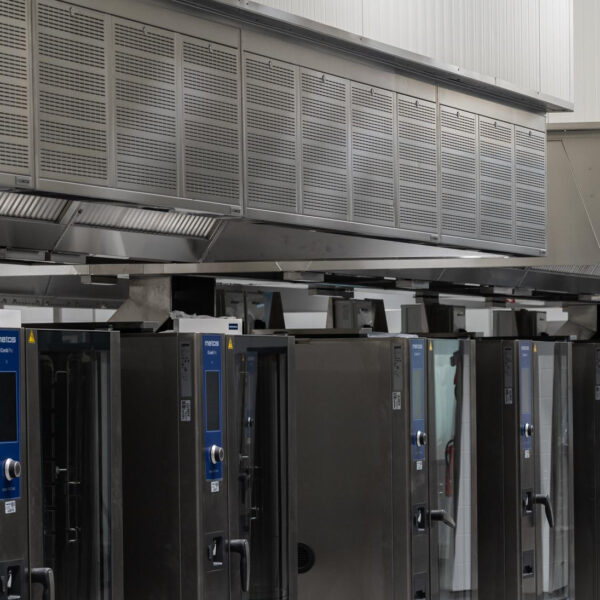
NEW: Demand-controlled ventilation saves energy in professional kitchens

Climecon brings a new innovation to professional kitchen ventilation, which can reduce the energy consumption of kitchen ventilation by at least 50 %. OptiDemand DCKV technology, available in all Climecon hoods and ceiling ventilation solutions, provides demand-controlled ventilation for professional kitchens. Demand-controlled, intelligent ventilation saves energy, and employees always have optimal working conditions.

The OptiDemand system measures the ventilation of the entire kitchen, and the data collected by the hood provides an accurate picture of the kitchen’s usage situation. Ventilation can be controlled in an area-specific way and made more efficient when the utilization rate is high, and energy is not wasted. Demand control is especially welcome for the property owner, maintenance, and maintenance partner, as it also makes it possible to identify the need for maintenance and schedule measures on time. The innovation is scalable and suitable for small and large professional kitchens. With OptiDemand, you can ensure that the kitchen and restaurant always have a good indoor air climate for employees and customers.

Data can be used to improve the efficiency of building automation

The system monitors the air quality in the kitchen around the clock in real time. The OptiDemand system measures the indoor air in the kitchen with the help of several different sensors, providing reliable information on the utilization rate of the kitchen. In addition to carbon dioxide, our system measures TVOCs, humidity, temperature, movement, and small particles that weaken air quality. In the Optidemand system, even a small kitchen has dozens of sensors, and larger kitchens have hundreds. The system’s ingenuity lies in its ability to combine a large amount of information into a logical entity, making it easy to control the ventilation system. The deliveries also include ultrasonic control dampers, which make area-specific control easy to implement. The system can operate in stand-alone mode, or it can be combined with building automation and various management and maintenance systems.

Trends can be identified in kitchen operations, which allows ventilation to be further optimized. “The demand-based ventilation is becoming a standard solution in professional kitchens. The designers of kitchen sites understand the importance of energy saving and get a Nordic and high-quality solution for their customers from this,” says Ville Wallendahr, Director of Profesional Kitchens at Climecon.

Get to know OptiDemand solution


Do you want to hear more?
Don’t hesitate to contact Ville

News

Top-quality indoor climate through smart choices – insights from Engineering Company Lappialämpö

According to Tero Lehtola, CEO of Lappialämpö, the indoor climate quality can be influenced surprisingly much even by the choice of diffusers. In Lappialämpö’s projects, the combination of HRV units, duct coils, and our RINO and LINE diffusers forms an effective system that ensures an even, draft-free indoor climate—just as it should be in comfortable, functional spaces. Lappialämpö Oy is a reliable full-service building services engineering company in the Lapland region, with a particular strength in high-quality, comprehensive HVAC design.

Read more

Get to know: Sales Manager Veli-Matti Piispanen

A favorite among customers, Veli-Matti knows snow and rain covers, roof hoods, and hoods like the back of his hand. Veli-Matti, or Velsu as he’s known to friends, has been working at Climecon since 1999. In addition to his sales role, he also helps manage products for snow and rain covers, and roof hoods together with the Product Manager. His enthusiasm for his work is as strong as it was at the start of his career, and as a thrill-seeker, Velsu is always ready for new adventures.

Read more

Manage life cycle costs effectively – energy-saving smart ventilation

The costs of a construction project do not end when the building site is completed. The real expenses accumulate over the entire lifecycle of the building: from energy use, maintenance, and the lifespan of the systems. When new systems are put out to tender, the purchase price alone does not reveal the total cost of the investment. The Life Cycle Costs show which solution is truly sensible both economically and environmentally. When solutions are designed to be long-lasting and energy-efficient, the building consumes less energy, emissions decrease, and indoor air quality remains high year after year.

Read more