
Vent.X tips – Throw pattern designer

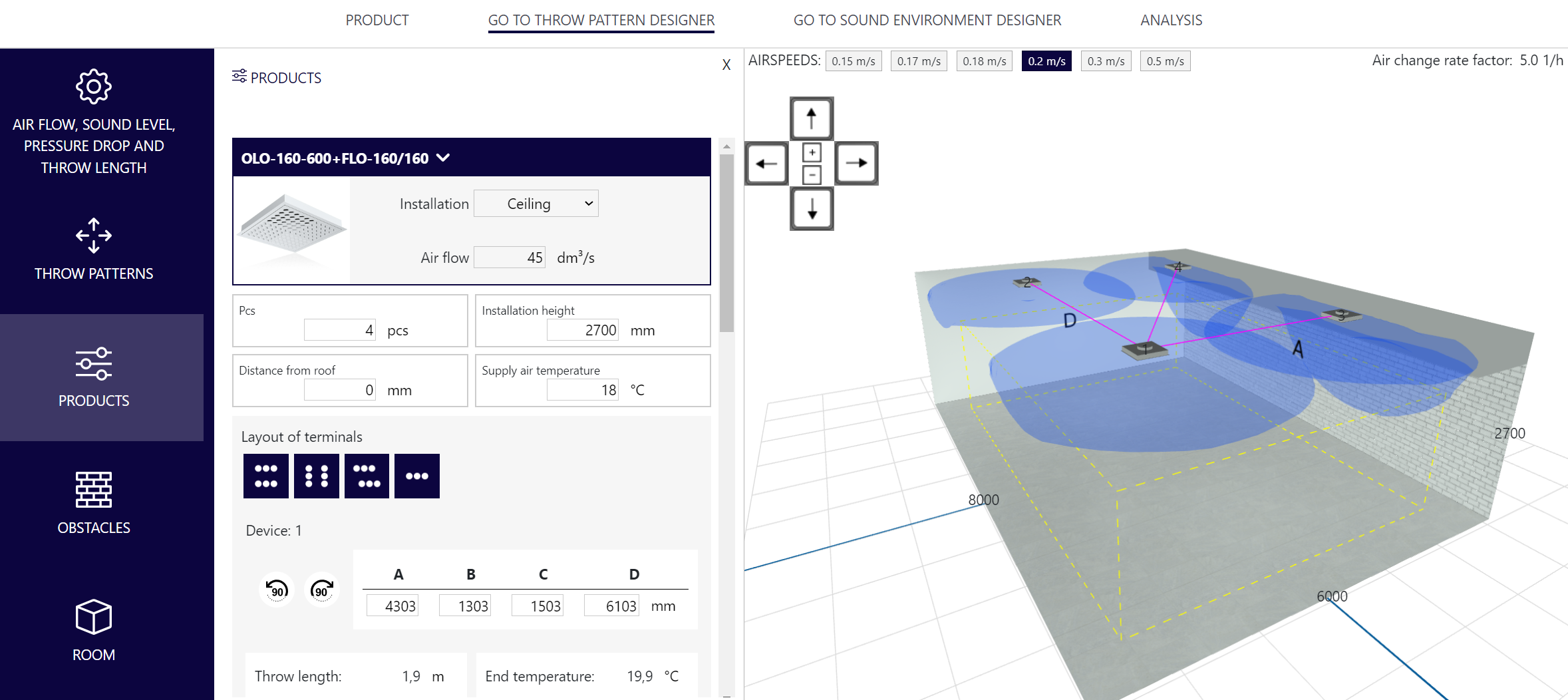
In this article, we explain in more detail what is included in the Throw pattern designer tab. You can access the design of the throw pattern designer from the tabs in the Products front page. From the menus that open on the left side of the view, you can change the information of the device, room and throw patterns. Everything you need is easily in one view.

Airflow, sound level, pressure drop and throw length: The device information can be edited and the airflow can be adjusted to a certain level or according to the structure of the space in this menu. If there is more than one air terminal device in the plan, the information of each device can be edited from the drop-down menu below.

Throw patterns: You can choose the most suitable throw pattern for the device or direct the throw pattern as required.

Devices: The location, size, number, installation height, or supply air temperature of the device(s) can be changed in this menu. If there are several devices in the plan, you can use their location buttons at the bottom of the menu. If the device can be installed both on the ceiling and on the wall, you can choose the installation location.

Obstacles: You can add obstacles to the space, and define their dimensions and locations. Obstacles can be used to model, for example, beam structures in the ceiling.

Room: Enter the dimensions of the room from the menu, if necessary, you can add a lower ceiling grid, which also works as a snap net for transferring terminal devices.

Air speeds: From the upper left corner of the simulation screen, you can activate at which air speeds the throw patterns are displayed.

Air change rate factor: In the upper right corner of the simulation screen, you can see the air change rate factor of the space.
Go to Vent.X

More Vent.X tips

adding obstacles

News

More performance without compromise – The advantages of nozzle ducts in HVAC design

Nozzle ducts have established themselves in ventilation design as a solution that combines efficiency, occupant comfort, and an appearance appreciated by architects. From an HVAC designer’s perspective, their key strength lies in their ability to simultaneously solve several air distribution challenges: handling large air volumes, draught-free ventilation, low noise levels, and space-efficient implementation.

Read more

Concrete actions towards a 1.5°C future

Climecon’s climate work is built on measurable actions, verified data, and determined progress toward the Science Based Targets initiative (SBTi). We drive emission reductions systematically—grounded in facts, measuring impact, and continuously improving over the long term. The 2025 carbon footprint calculation shows that our work is delivering results, particularly where the impact is fastest and most significant.

Read more

100% EPD coverage for Climecon products

In 2020, we promised that by 2025 all Climecon products would have an Environmental Product Declaration (EPD). Now, the entire product portfolio has been EPD-calculated. This marks a significant milestone on our journey toward a more responsible and transparent construction market. EPDs provide a consistent, standardized, and accurate way to assess the environmental impacts of building products.

Read more